
Eliminate Thermal Bridges
The #1 European solution against thermal bridges. A nanotechnology skim coat that goes on like plaster and stops heat loss where traditional insulation fails.
Theory & regulation
What thermal bridges are
Thermal bridges are one of the most complex topics in assessing a building's energy performance. Poor design or execution of construction details causes harmful effects both on comfort — mold and surface condensation — and on economics, with a sharp rise in energy consumption.
A thermal bridge influences an area of at least 3 times the element thickness, and never less than 1 meter (UNI EN ISO 14683).
“Part of the building envelope where the thermal resistance, elsewhere uniform, changes significantly due to penetration of materials with different conductivity, a change in thickness, or a difference between inner and outer dispersing surfaces.”
The problem
Where thermal bridges hide
Every geometric or material discontinuity in the envelope becomes a weak point: heat flow concentrates, the surface temperature drops and condensation and mold appear. These are the critical nodes classified by UNI EN ISO 14683.
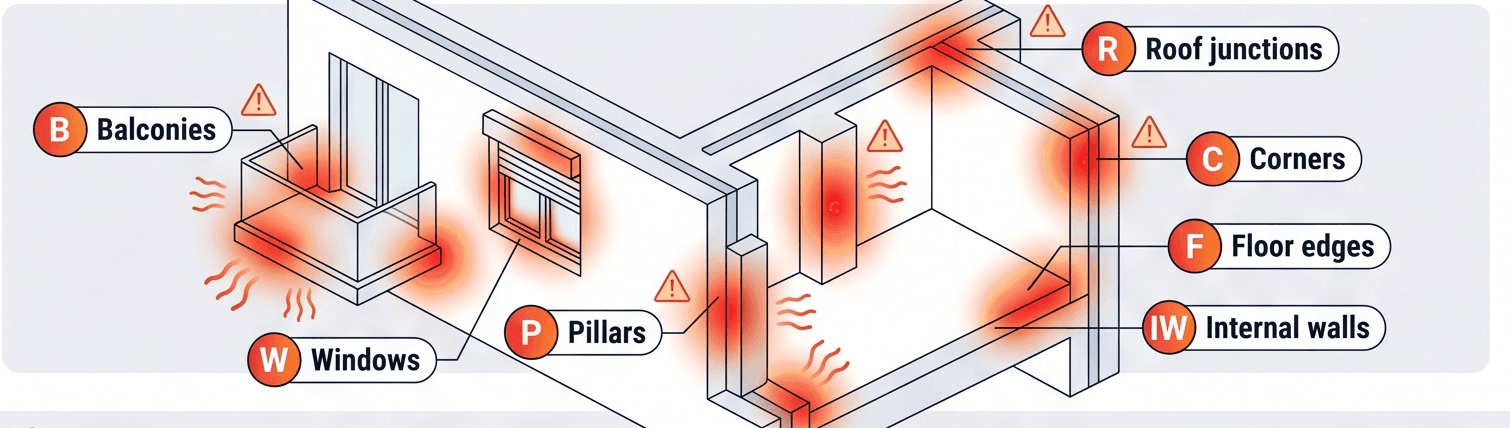
- R
Roof junctions
Connection between the roof slab and the vertical wall.
- C
Corners
Intersection of two vertical walls, outward or inward.
- F
Floor edges
Connection of bases and walls facing outside or unheated spaces.
- IW
Internal walls
Junction between an inner partition and the outer wall.
- P
Pillars
A pillar interrupting the continuity of the insulating layer.
- B
Balconies
A horizontal element linking indoor and outdoor spaces.
- W
Windows
Frame, sill and shutter box interrupting the insulation.
All the weak points in the building envelope

21-23%
Heat loss

80%
Mold above 80% humidity

Surface condensation

Failed energy compliance
The solution — iGK2 nanotechnology
One of the lowest thermal conductivities in the industry
λD = 0,0019W/mK
one of the lowest thermal conductivities on the market
- Restores thermal continuity across every critical node
- No bulk: solves thermal bridges without rebuilding the envelope
- Corrects from the inside, even where external insulation cannot reach
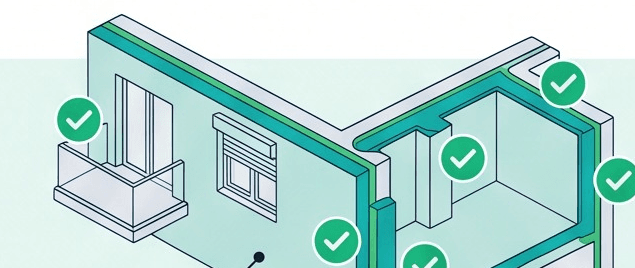
Proven performance
Reduction in thermal transmittance
-87%
Pillars
-77%
Roller shutter box
-73%
Balconies
-65%
Corner walls
Reduction in thermal transmittance (finite element simulation)
Application — 6 steps
As simple as a skim coat

Prepare
Clean and prepare the surface.

Mix
Shake and homogenize iGK2.

1st Coat
Lay the first coat.

Mesh
Embed the fiberglass mesh.
2nd Coat
Apply the second coat.

Finish
Smooth to a clean finish.
Apply it like a skim coat with a standard toothed trowel: no panels, no anchors, no demolition. If you can plaster, you can apply iGK2.
Internal + external walls
One product. Every wall.
Suitable for any surface, residential or commercial, indoors and out.




 ISO 14021:2016
Got a thermal bridge to solve?
Our technicians analyze the critical node and propose the iGK2 correction, with a detailed quote and no obligation.
Request a consultation